

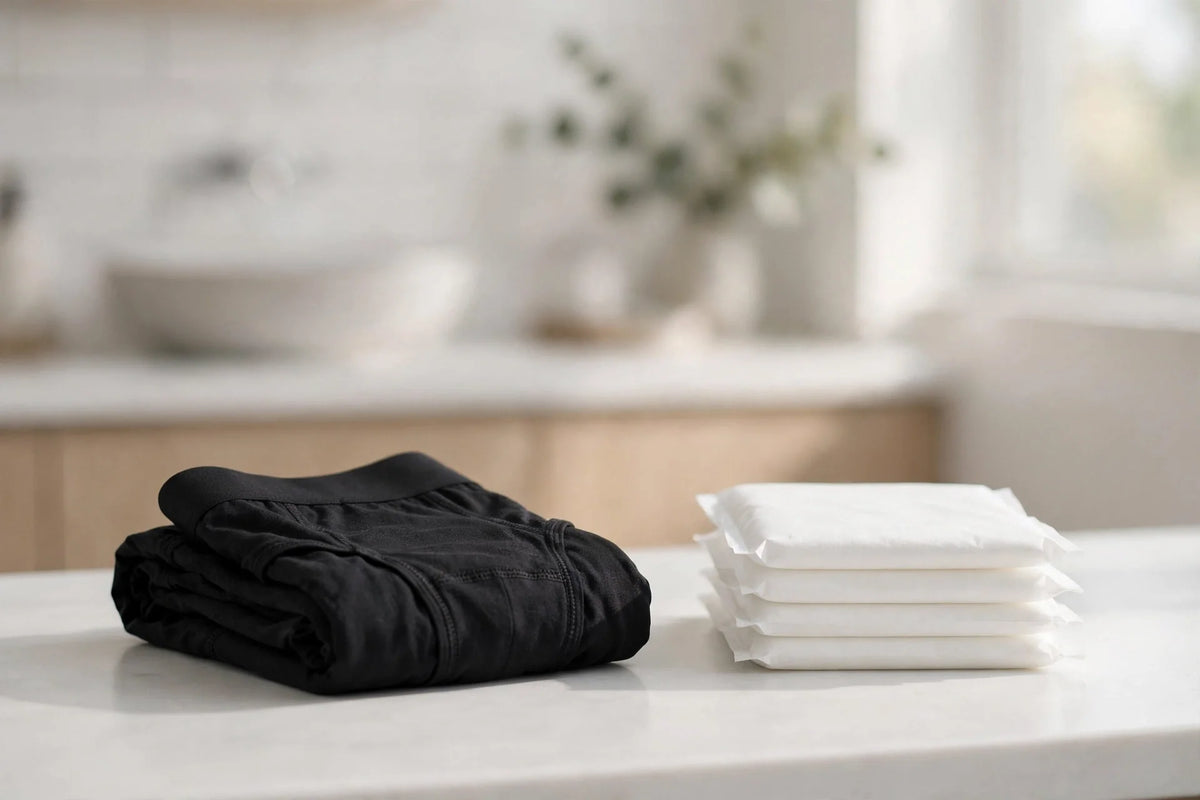
If you manage bladder leaks, you've probably faced this choice: keep buying disposable pads, or switch to reusable leakproof underwear? Both options absorb leaks, but they differ a lot in long-term cost, comfort, and environmental impact.
The short answer: disposable pads cost less upfront but become expensive within a few months, while reusable leakproof underwear costs more at first and then saves you money — usually breaking even in 3–4 months. Reusable options are also softer against skin and far better for the planet. Below, we compare the two side by side so you can decide what's right for you.

Disposable vs. Reusable: Side-by-Side Comparison
| Disposable Pads | Reusable Leakproof Underwear | |
|---|---|---|
| Upfront cost | Low — a few dollars per pack | Higher — $20–$30 per pair |
| Cost per month (ongoing) | $30–$60 for daily users | $0 after the initial purchase |
| Break-even point | — | Usually 3–4 months |
| Comfort | Can feel bulky; crinkly backing | Feels like regular underwear |
| Discretion | May show under fitted clothing | Invisible under clothes |
| Odor control | Fragranced options mask odor | Absorbent core locks in moisture; proper washing prevents odor |
| Skin health | Plastic backing can trap heat | Breathable fabrics reduce irritation |
| Environmental impact | ~1,000+ pads per year in landfill | One set lasts 1–2 years |
| Convenience | Use and throw away | Needs washing after use |
Cost: Doing the Math
Disposable pads look cheap — often $0.40–$0.80 each. But if you use 2–3 per day, that's $30–$60 every month, or $360–$720 per year, forever.
Reusable leakproof underwear costs around $20–$30 per pair. Most people need 5–7 pairs to rotate through the week, so the upfront investment is roughly $100–$210. Each pair typically lasts 1–2 years with proper care, which brings the effective cost down to about $8–$18 per month — and drops to zero once you've bought your set.
For most daily users, reusable underwear pays for itself within 3–4 months. After that, you're saving money every single month.
Comfort and Discretion
Modern reusable leakproof underwear is built to look and feel like regular underwear. Products like Rooces women's washable incontinence underwear and Rooces men's discreet incontinence underwear use a multi-layer absorbent core that stays thin and flexible — no bulk, no crinkle sound, nothing visible under fitted pants or dresses.
Disposable pads, by contrast, sit inside your regular underwear. They can shift during the day, feel bulky, and the plastic backing traps heat and moisture against the skin, which can cause irritation with long-term use. If you've ever wondered how to choose the right absorbency, the same logic applies: the right fit matters more than the format.
To understand exactly what makes reusable options work, see how reusable bladder leak underwear works: materials, layers, and comfort features.
Sustainability: The Hidden Cost of Disposables
A daily disposable-pad user throws away over 1,000 pads a year — pads that contain plastics and superabsorbent polymers and take decades to break down. A set of reusable underwear replaces all of that waste for 1–2 years, then gets replaced as a small handful of garments.
If reducing waste matters to you, reusables are the clear winner. Pair them with a machine wash laundry bag to protect the absorbent layers in the wash, and a waterproof carry pouch for discreet storage when you're out.
When Disposables Still Make Sense
Reusables win on cost, comfort, and sustainability — but disposables have their place:
- Travel: when you can't do laundry, disposables are simpler. (See our tips for traveling with incontinence.)
- Post-surgery recovery: during the first weeks after procedures like prostate surgery, when laundry feels like too much.
- Trial period: if you're not sure about your absorbency needs yet, a small pack of disposables can help you learn your patterns before investing. Our light vs. moderate absorbency guide can help you decide.
- Backup: many reusable users keep a few disposables as emergency backup.
How to Switch to Reusable (Without the Learning Curve)
- Start with 3 pairs — enough to test fit and absorbency before committing. A practical buyer's guide walks through sizing and styles.
- Wash before first wear — this activates the absorbent fibers. Follow our washing and care guide to make each pair last.
- Build up to a full week's set — 5–7 pairs means you only do one extra laundry load per week.
- Consider booster options — for heavier days, a reusable absorbent pad or underwear with a removable pad adds capacity without going disposable.
Frequently Asked Questions
Are reusable incontinence underwear as absorbent as disposable pads?
Yes — quality reusable underwear matches light to moderate disposable pads, and options with removable booster pads handle heavier needs. The key is choosing the right absorbency level for your leaks.
Do reusable leakproof underwear smell?
Not when cared for properly. The absorbent core locks moisture away from the surface, and machine washing with the right routine prevents odor buildup. Avoid fabric softeners, which coat the fibers and reduce absorbency.
How long does reusable incontinence underwear last?
Typically 1–2 years (roughly 200+ washes) with proper care — cold or warm machine wash, no bleach, no fabric softener, and air-drying or low-heat tumble drying.
Is it hygienic to wash leakproof underwear with other clothes?
Yes. A normal machine wash with detergent fully cleans them. Using a laundry bag keeps them separate and protects the waterproof layer.
The Bottom Line
If you deal with bladder leaks regularly, reusable leakproof underwear is the better long-term choice: lower cost after a few months, better comfort and discretion, and far less waste. Disposables still work well as a travel or backup option — many people use both.
Ready to make the switch? Browse women's and men's reusable leakproof underwear, or read our complete guide to choosing incontinence underwear first.



Share:
Why Does My Urine Smell Strong? Common Causes and When to Pay Attention
Can Caffeine Cause Bladder Leaks? What Your Drinks Do to Your Bladder